
Every organisation wants better operational decisions:
- Faster incident resolution
- Improved service resilience
- Reduced operational costs
- Higher customer satisfaction
Yet few organisations stop to ask a critical question: how reliable is the information driving those decisions?
In most operational environments, decisions are only as good as the signals available to the teams making them. If the data is incomplete, delayed or lacking context, even the most experienced engineers will struggle to identify emerging risks before they become business problems.
This challenge is becoming increasingly significant as enterprise environments grow in scale and complexity. Networks span multiple vendors. Applications operate across hybrid cloud environments. Services depend on hundreds of interconnected infrastructure components, and operational events occur continuously.
The issue is no longer visibility. The issue is ensuring that operational intelligence is built upon accurate, real-time and contextual operational signals.
This is where Model-Driven Telemetry becomes strategically important — not because it improves monitoring, but because it provides the signal intelligence foundation required to power Predictive Operational Intelligence.
Why Traditional Data Collection Is Holding Operations Back
For decades, network operations relied on technologies such as SNMP polling, CLI scraping, periodic log collection and manual diagnostics. These approaches were effective when environments were relatively static and infrastructure changed slowly.
Today’s operational reality is very different. Modern digital environments generate millions of operational signals every hour — routing changes, performance variations, service dependencies, configuration updates, capacity fluctuations and infrastructure events.
The volume and speed of change have exceeded the capabilities of traditional polling-based approaches. The challenge is no longer collecting data. The challenge is collecting the right operational signals at the precise moment they matter.
Periodic polling creates gaps. Gaps create uncertainty. And uncertainty increases operational risk. Organisations seeking to build Predictive Operational Intelligence require continuous operational awareness rather than occasional snapshots of reality.
Model-Driven Telemetry: From Data Collection to Signal Intelligence
Model-Driven Telemetry (MDT) represents a fundamental shift in how operational signals are collected and consumed. Traditional monitoring platforms repeatedly ask infrastructure for information. Model-Driven Telemetry works differently: infrastructure continuously shares operational state information as changes occur.
Instead of waiting for systems to request updates, devices stream operational signals in real time. This creates a dynamic and continuously evolving picture of operational health.
At the heart of MDT are standardised YANG data models. These models define how operational information should be structured, interpreted and exchanged across multi-vendor environments. Using technologies such as:
- gNMI
- NETCONF
- gRPC
- Secure streaming transports
organisations can create a consistent and scalable flow of operational intelligence across their infrastructure landscape. The result is not simply better visibility. It is better understanding.
The Four Foundations of Signal Intelligence
Standardised Operational Models
YANG models provide a consistent language for describing operational state. This eliminates much of the complexity associated with proprietary formats and fragmented data structures, giving operational teams a unified understanding across diverse infrastructure environments.
Continuous Signal Streaming
Rather than relying on periodic collection cycles, operational signals are streamed as they occur. This enables real-time awareness and significantly improves the speed of operational decision-making.
High-Fidelity Operational Context
Modern encoding mechanisms provide rich operational detail whilst minimising resource consumption. Teams gain access to more accurate operational signals without introducing unnecessary overhead.
Vendor-Neutral Flexibility
MDT enables organisations to build intelligence strategies independent of individual technology vendors. This creates operational consistency whilst supporting long-term infrastructure evolution.
Together, these capabilities establish the signal intelligence foundation required for Predictive Operational Intelligence.
Why Signal Intelligence Matters More Than Visibility
Many organisations continue to focus on improving visibility. Whilst visibility remains important, it is no longer sufficient. The real competitive advantage lies in understanding — and understanding requires context, which in turn requires high-quality operational signals.
This distinction becomes particularly important during operational incidents. When service degradation occurs, operations teams must quickly answer questions such as:
- What changed?
- Which services are affected?
- Which customers are impacted?
- Is this an isolated issue or a wider pattern?
- What should happen next?
Without accurate and continuous operational signals, these questions become difficult to answer. With MDT, organisations gain the operational context required to make faster and more confident decisions.
From Telemetry to Predictive Operational Intelligence
Collecting operational signals is only the beginning. Signals alone do not create intelligence. The true value emerges when those signals are interpreted, correlated and transformed into operational understanding.
This is where KAATHAM Intelligence becomes critical. By continuously analysing telemetry streams, behavioural patterns, infrastructure relationships and operational history, KAATHAM transforms raw operational signals into actionable intelligence. This enables:
- Predictive risk identification
- AI-Assisted Root Cause Intelligence
- Service impact awareness
- Capacity forecasting
- Operational prioritisation
- Intelligent remediation recommendations
The objective is not to react faster. The objective is to prevent disruption altogether. This represents the transition from reactive operations to Predictive Operational Intelligence.
Reducing MTTR Through Continuous Operational Context
One of the most valuable outcomes of MDT is its ability to provide continuous operational context. Traditional troubleshooting often begins after the incident has already occurred, with engineers spending valuable time reconstructing events from incomplete information.
With continuous telemetry streams, organisations maintain a living operational history. Teams can immediately understand:
- What changed before the incident
- Which signals appeared first
- Which infrastructure elements were involved
- How the issue evolved over time
- Which services experienced impact
This dramatically accelerates operational understanding and helps reduce Mean Time to Resolution. More importantly, it reduces uncertainty — often the most expensive part of any operational incident.
How iNOSnet and KAATHAM Transform Signals into Decisions
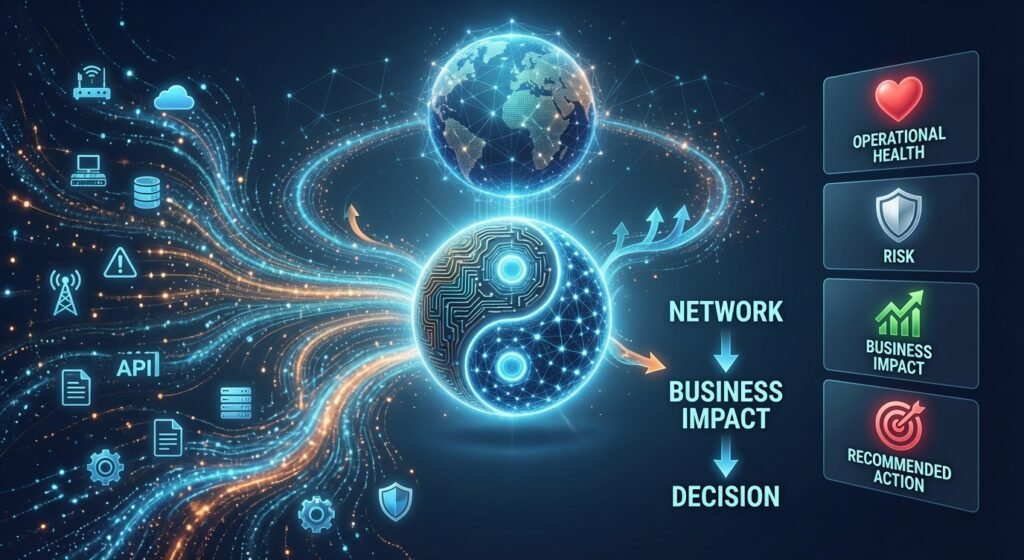
The role of iNOSnet is not simply to collect information. Its purpose is to transform operational complexity into operational clarity. Powered by KAATHAM Intelligence, the platform continuously ingests operational signals, creates operational context, correlates behavioural patterns, identifies emerging risks, prioritises operational actions and supports intelligent automation.
This creates a continuous intelligence cycle:
- Infrastructure generates operational signals. Telemetry streams provide real-time visibility into operational behaviour.
- KAATHAM creates operational understanding. Operational signals are analysed, contextualised and prioritised.
- iNOSnet enables operational decisions. Teams receive actionable intelligence rather than disconnected events.
- Organisations operate with greater confidence. Decisions become faster, smarter and more consistent.
This is the essence of Predictive Operational Intelligence.
The Future of Operations Starts with Better Signals
Every operational decision begins with a signal, and the quality of those signals determines the quality of the outcome. As enterprise environments continue to increase in complexity, organisations will need more than monitoring. They will need more than observability. They will need a foundation capable of supporting intelligent operational decisions at scale.
Model-Driven Telemetry provides that foundation — not as a monitoring technology, but as the signal intelligence layer that enables Predictive Operational Intelligence.
Because the future of Intelligent Network Operations is not about collecting more data. It is about understanding what the data is trying to tell you before disruption occurs. And that journey begins with better signals.
