

When a major service disruption occurs, the post-incident review often follows a familiar pattern. Engineers gather in meeting rooms and virtual war rooms, reconstructing timelines, reviewing operational signals, analysing logs and examining every change that occurred in the hours leading up to the incident. Eventually, somebody discovers the clue:
- A latency spike that appeared insignificant at the time
- A routing anomaly buried amongst hundreds of operational notifications
- A recurring warning that had triggered so often it became background noise
- A configuration change that seemed unrelated until viewed in the wider operational context
The signal was there. The Operational Visibility tools captured it. The information existed. Yet the outage still occurred.
This raises a difficult question that many organisations are beginning to confront: if we have more Operational Visibility into our infrastructure than ever before, why do service disruptions continue to impact customers, revenue and reputation?
The answer reveals a fundamental flaw in how most organisations approach operations. They assume visibility creates understanding. In reality, Operational Visibility and Operational Understanding are two very different things.
The Operational Visibility Paradox
Over the last decade, organisations have invested heavily in technologies designed to improve Operational Visibility. Network management platforms provide detailed performance metrics. Application platforms track transactions and user experience. Cloud environments generate infrastructure insights at unprecedented scale. Security platforms monitor threats in real time. The result is an extraordinary volume of operational information.
Yet despite this investment, many operations teams feel less in control than they did ten years ago. The reason is simple: the amount of information has grown exponentially, but the ability to transform that information into Operational Understanding has not.
Most Network Operations Centres are no longer struggling with a lack of Operational Visibility. They are struggling with an excess of it. Engineers spend their days moving between dashboards, correlating operational signals from multiple systems, comparing logs, analysing topology relationships and attempting to build a coherent picture from fragmented information.
The challenge is no longer seeing the network. The challenge is understanding what the network is trying to tell you.
Modern Networks Have Become Living Operational Ecosystems
One of the reasons traditional monitoring is losing effectiveness is that modern infrastructure no longer behaves like traditional infrastructure. Networks were once relatively predictable environments consisting of routers, switches, circuits and servers operating within clearly defined boundaries.
Today’s environments are entirely different. Applications move dynamically between cloud environments. Users connect from anywhere. Services rely on dozens of interconnected systems. Infrastructure spans data centres, cloud platforms, SaaS applications and edge environments. A single customer transaction may traverse multiple providers, technologies and operational domains before it completes.
The network has evolved from a collection of devices into a living operational ecosystem. Yet many organisations continue to manage it using tools designed for a much simpler era.
Why Operational Visibility Alone Cannot Prevent Failure
Traditional monitoring excels at identifying symptoms. It can tell you that CPU utilisation has increased. It can tell you that a link is congested. It can tell you that application response times have degraded.
What it cannot reliably tell you is why those events matter. It cannot always determine whether a symptom is isolated or part of a broader operational pattern. It cannot always identify which customers are affected. It cannot consistently predict how a situation is likely to evolve. Most importantly, it cannot reliably answer the question every operations leader asks during a major incident: “What should we do next?”
This is the gap between Operational Visibility and Operational Intelligence. Monitoring collects information. Operational Intelligence creates understanding. Operational Decision Intelligence transforms understanding into action.
The Cost of Operating Without Operational Context
Every operational leader understands the financial impact of downtime. What is often underestimated is the cost of uncertainty.
When teams lack operational context, incidents take longer to diagnose. Escalations occur earlier and more frequently. Senior engineers become involved in issues that should have been resolved at lower levels. Multiple teams investigate the same symptoms independently. Operational Decision-Making slows precisely when speed matters most.
The longer uncertainty persists, the more expensive the incident becomes. This cost is not measured solely in downtime. It appears in operational expenditure, reduced productivity, delayed projects, employee burnout and declining customer confidence. In many organisations, the hidden cost of uncertainty exceeds the cost of the technical failure itself.
Visibility, Observability and Operational Intelligence Are Not the Same Thing
Many organisations use the terms monitoring, observability and operational intelligence interchangeably. They should not. Each represents a different stage of operational maturity.
- Operational Visibility — the ability to collect, display and monitor operational data across infrastructure, applications and services.
- Observability — the ability to investigate and analyse operational behaviour using telemetry, logs, metrics and traces.
- Operational Intelligence — the ability to understand context, business impact and likely operational outcomes.
- Operational Decision Intelligence — the ability to prioritise actions, recommend responses and accelerate decision-making.
Most organisations have already invested heavily in Operational Visibility. Many are adopting observability. Very few have achieved Predictive Operational Intelligence. Yet it is this final stage that enables organisations to move from reacting to disruption towards preventing it altogether.
The Emergence of Predictive Operational Intelligence
The next phase of operational maturity is already beginning to emerge. Forward-thinking organisations are shifting their focus away from collecting more data and towards extracting more intelligence from the operational signals they already possess.
This shift is giving rise to a new operational model: Predictive Operational Intelligence. Rather than simply reporting what has happened, it continuously analyses operational signals, identifies patterns, understands context and predicts likely outcomes.
Instead of asking “what failed?”, operations teams begin asking “what is likely to fail next?” That shift changes everything. The conversation moves:
- From reaction to prevention
- From investigation to understanding
- From firefighting to foresight
- From Operational Visibility to Operational Understanding
- From data collection to Operational Decision Intelligence
Why Operational Intelligence Matters More Than Ever
The organisations that will thrive over the next decade are unlikely to be those with the most monitoring tools. They will be the organisations capable of making the fastest and most informed operational decisions.
In an increasingly digital economy, operational speed has become a competitive advantage:
- The ability to identify emerging risks before customers notice them
- The ability to understand business impact before services fail
- The ability to prioritise the right actions before incidents escalate
- The ability to transform operational complexity into Operational Clarity
These capabilities create measurable business value — not because they eliminate failure, but because they enable organisations to respond with greater confidence, understanding and speed.
Where KAATHAM Fits Into the Future of Operations
KAATHAM was built around a simple observation: most organisations do not suffer from a lack of operational information. They suffer from a lack of Operational Understanding.
Powered by Signal Intelligence and Agentic AI, KAATHAM continuously transforms operational signals into Operational Understanding by correlating:
- Operational signals
- Topology intelligence
- Change intelligence
- Service dependencies
- Historical operational behaviour
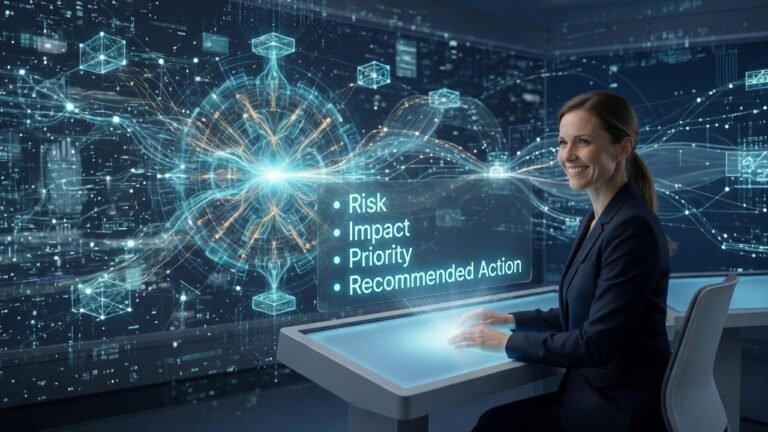
This creates a unified understanding of operational health across complex environments. Instead of forcing teams to navigate multiple dashboards in search of answers, KAATHAM helps them understand:
- What is happening
- Why it matters
- Which business services are affected
- Which customers are at risk
- What action should be prioritised next
This is not simply monitoring. It is not even observability. It is Predictive Operational Intelligence — and increasingly, it is becoming the difference between organisations that react to disruption and organisations that prevent it.
The Future Belongs to Organisations That Can See Beyond the Signal
Most operational failures do not arrive without warning. The operational signals are usually present long before the outage appears. The challenge is recognising them early enough to act.
As digital infrastructure continues to increase in complexity, Operational Visibility alone will no longer be sufficient. The organisations that succeed will be those capable of transforming operational signals into operational foresight.
Because in 2026 and beyond, the real competitive advantage is not knowing what happened. It is understanding what happens next. That is the promise of Predictive Operational Intelligence, and that is the future of Intelligent Network Operations.
See. Predict. Act. Before Your Network Fails.